Champaign County Planning and Zoning
John Hall
Champaign County MS4 Storm Water Program
BACKGROUND
The Clean Water Act was passed by Congress in 1972 to help protect the nations waterways. From this act, the Environmental Protection Agency (EPA) created the National Pollutant Discharge Elimination System (NPDES) Program. The NPDES is a comprehensive National Stormwater Program for addressing the non-agricultural sources of storm water discharges which adversely affect the quality of our nation's waters. Champaign County was identified as a Municipal Separate Storm Sewer System (MS4) in 2003 and is responsible for monitoring point-source discharge and storm sewer infrastructure that falls within County jurisdiction.
Part of the MS4 requirements is to keep an updated Notice of Intent (NOI). The NOI explains how Champaign County implements six minimum control measures to support water quality within all stormwater discharge. These control measures each contain Best Management Practices (BMP) and are as follows:
- Public Education and Outreach - Develop and implement programs and material in order to educate the public on the various ways to reduce storm water pollution.
- Public Participation and Involvement - Involve Champaign County residents in developing, implementing, and reviewing activities that encourage clean water practices.
- Illicit Discharge Detection and Elimination - Identify harmful discharges and spills to drainage systems and implement enforcement strategies.
- Construction Site Runoff Control - Instruct construction site operators to manage storm water runoff to reduce or eliminate pollution from construction sites.
- Post-Construction Runoff Control - Enable property owners to manage storm water runoff to reduce pollution from a site after construction activities have ended.
- Pollution Prevention and Good Housekeeping – Champaign County aims to minimize pollution from its own properties and facilities by reducing stormwater runoff pollution from pavement and open spaces from entering stormwater systems and local waterways.
A copy of the most current NOI as well as reports from past years can be viewed below. The report goes into detail of selected BMPs for the reporting year, summarizes the following years activities, and contains information on the annual stormwater survey conducted by Champaign County. A link to the survey is provided and can be taken at any time.
- MS4 Area Map
- Champaign County MS4 Area Storm Water Survey
- Notice of Intent for New or Renewal of General Permit for Discharges from Small Municipal Separate Storm Sewer Systems - MS4's
- Annual Facility Inspection Report for the period 3/2020 - 3/2021
- Annual Facility Inspection Report for the period 3/2021 - 3/2022
- Annual Facility Inspection Report for the period 3/2022 - 3/2023
- Annual Facility Inspection Report for the period 3/2023 - 3/2024
- Annual Facility Inspection Report for the period 3/2024 - 3/2025
Green infrastructure is the use of natural or vegetative-based mechanisms to manage storm water runoff volume and water quality. Gray infrastructure, like inlets and stormwater pipes, typically only direct stormwater to streams and rivers. Green infrastructure is a multifaceted approach to storm water management. It reduces storm water flows to sewer systems while having economic, environmental and social benefits.
Below are a few ways to implement green infrastructure on your property:
- Rain Barrels – Directing downspouts into rain barrels from rooftop runoff helps reduce the amount going into storm sewers. The water collected can be reused for lawncare or gardening. Rain Barrel Information.
- Rain Gardens – Rain gardens are small, constructed basins that collect and absorb storm water runoff. These gardens are comprised of water-resistant plants that can filter pollutants and help with water infiltration. These gardens can also create habitat for beneficial wildlife and improve the overall aesthetics of a property. Rain Garden Information.
- Permeable Pavement – Traditional concrete and other paved surfaces do not allow water to infiltrate into the ground. Permeable pavements allow for water to soak through and minimize the amount of runoff carried to storm sewer systems. Permeable Pavement Information.
- Planting Trees – Trees help reduce surface volume runoff through their roots and canopy cover. Consider looking at cost savings and additional information through the Arbor Day Foundation Value of Trees page & calculator. Tree Planting Information.
- Native Plants – Replacing bare areas or grass with native plants can establish better surface drainage and encourage pollinator habitats. The Illinois Department of Natural Resources has extensive information regarding plants. Native Plant Information.
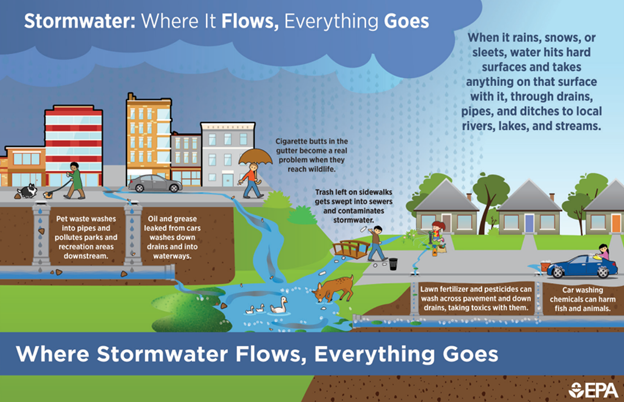
Storm water can pick up chemicals, debris and other pollutants from our lawns which flow into storm sewer systems. These materials are then eventually discharged, untreated, into local rivers, lakes and streams. Pesticides, lawn chemicals, pet waste and other pollutants found on lawns and personal property can be carried off by storm water runoff.
There are numerous ways to minimize the risk of polluting storm water runoff.
A few ways you can minimize risk:
- Use fertilizers and lawn chemicals sparingly. Read the labels for proper application and disposal.
- Clean up after your pets.
- Consider planting native pollinator plants in place of grass or turf.
- Vegetate places with exposed soil.
- Downspouts should be placed to drain onto vegetated areas, not pavement.
- Don’t mow your grass too low.
- Sprinklers should be adjusted to not water paved areas.
- Lawn trimmings and other yard waste should be kept off paved areas. Compost if possible.
As a resident:
- Take your vehicle to commercial washing facilities instead of washing at home. These facilities have filtering systems in place, which minimize pollutants entering storm sewer systems.
- Ensure septic systems are maintained to function as intended. Inspect your system every other year and pump it out as necessary.
- Consider better lawn care practices. See our Sustainable Lawn Care dropdown for more information.
As a business owner:
- Ensure dumpsters and grease storage are covered and kept clean to prevent leaks of polluted materials.
- Sweep and clean up litter & debris from parking lots.
- Hazardous chemicals and materials should be stored properly. In the event of a spill, have a spill kit ready and ensure that employees are trained on proper usage.
Linked below are two infographics that have a variety of information regarding identifying stormwater problems, how to combat them, and other useful information from related websites.
Champaign County works with multiple other governmental entities in the County including the City of Champaign, City of Urbana, Village of Savoy, and the University of Illinois at Urbana-Champaign. These five partners in addition to the Champaign County Soil and Water Conservation District form the Champaign County Stormwater Partnership (CCSP). These groups all share resources with one another and develop similar strategies to fulfill their own separate MS4 permits. It is the goal of the CCSP to improve the quality of stormwater runoff in the area. More details can be found on the CCSP Website